
On 17 September 2026, the Israel Securities Authority (“ISA”) published the final text of its Directive to Fund Managers and Trustees on the Outsourcing of Investment Management in Mutual Funds, issued under Section 97(b) of the Joint Investment Trust Law, 5754-1994.
For the first time, there is a single, published rulebook for the model under which an Israeli mutual fund is managed day-to-day by an external, licensed portfolio manager – known locally as “hosting” – and for the use of external investment advisers to a fund. The directive takes effect 90 days after notice of its adoption is published in the Official Gazette (Reshumot); existing arrangements have one year from publication to conform.
Why this matters to you. Hosting is the established route by which an asset manager can run a publicly offered Israeli fund without first obtaining a fund-manager license of its own. According to the regulatory impact assessment (RIA) published with the Directive, some 266 funds – roughly 23% of all active Israeli mutual funds, with about NIS 50 billion in assets (around 12% of the industry) – are currently managed this way, through four hosting fund managers. The RIA is candid that the ISA tightened the regime because parts of the market had drifted from its original purpose; the final framework introduces clearer entry conditions and graduated requirements that increase with the scale of the hosted activity.
For a manager with a distinctive strategy that wants distribution to Israeli retail and advisory channels, the new rules make the terms of entry knowable in advance.
Who can be a hosted portfolio manager: the entry conditions
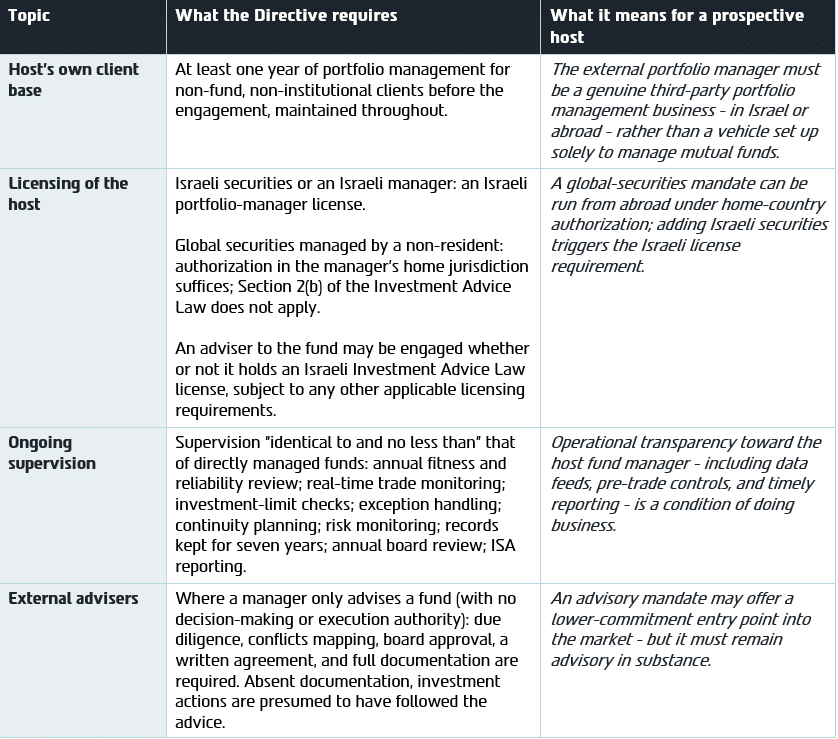
A fund manager may outsource investment management to either (i) a portfolio management company licensed under the Israeli Investment Advice Law or (ii) a non-Israeli resident, subject to the conditions set out in the Joint Investment Trust Law. A non-Israeli resident may participate in investment decisions concerning foreign securities only, excluding foreign securities issued by companies registered in Israel, and must be authorized under the laws of their country of residence to manage investments for others. For such a manager the Israeli licensing requirement (Section 2(b) of the Investment Advice Law) does not apply.
Three ways in: the models used in practice
In practice, several models are used to bring an external manager into an Israeli mutual fund. Which model fits depends on where the securities are traded and where the manager is based.
– Hosting of a local portfolio. The fund manager engages an external portfolio manager to manage the fund’s investment portfolio. Where the portfolio consists of Israeli securities, or the portfolio manager is Israeli, the portfolio manager must hold an Israeli portfolio-manager license.
– Hosting of a global portfolio. Where the mandate is for a global-securities portfolio – securities not traded on the Tel Aviv Stock Exchange – the portfolio manager does not need an Israeli license, but must hold a license or authorization in the jurisdiction in which it operates. This is the route most relevant to international managers, and the tiered requirements described below apply to it in the same way as they do to a portfolio manager operating under the Hosting framework.
– Advice to the fund. The external party provides investment recommendations only; the discretion whether to act on them rests entirely with the fund manager. The Directive permits the engagement of an external adviser whether or not the adviser holds an Israeli Investment Advice Law license; The Directive still requires the fund manager to conduct due diligence on the adviser, map conflicts, approve the engagement at the board level, and document how each recommendation was used; absent such documentation, investment actions are presumed to have followed the advice.
For an international manager, these models also describe a natural progression: begin as an adviser to an existing Israeli fund, move to a hosting mandate once the statutory conditions are satisfied, and – as assets grow through the tiers – consider establishing funds of one’s own under a fund-manager license.
The new requirements at a glance
The opportunity for global managers
For a global portfolio manager or fund manager, the combination of the Funds Law and the new Directive opens a clearer path into the Israeli retail fund market than has existed to date. A manager running a global-securities strategy may, where the applicable statutory conditions are satisfied, participate in the management of an Israeli mutual fund on the basis of its home-country authorization, without an Israeli portfolio-management license; the Israeli fund manager provides the license, trustee, distribution, and local infrastructure, while the international manager provides the strategy.
We suggest approaching the market in stages. Start as an adviser to an existing Israeli fund: the adviser may be engaged whether or not it holds an Israeli Investment Advice Law license, subject to any other applicable licensing requirements; the fund manager retains full discretion, and the arrangement can allow both sides to test the strategy and working relationship under the Directive’s documentation rules. Move to a hosting mandate for a global-securities portfolio, where the applicable statutory conditions are satisfied and the manager is authorized in the jurisdiction in which it operates. Then, as assets grow through the tiers and approach the applicable limits, consider whether to continue within the Hosting framework, restructure the business, or establish funds of your own, while meeting the equity, insurance, and governance requirements that apply to a fund manager.
The Directive (Hebrew): click here | The RIA report (Hebrew): click here
Our Investment Regulation, Trading, and Financial Instruments practice advises international asset managers on accessing the Israeli market – including advisory and hosting arrangements with Israeli fund managers, the licensing issues each model raises, the negotiation of host agreements, and the path to obtaining a fund manager license. We would be glad to discuss which route best fits your plans for the Israeli market.