
On January 5, 2026, the Tel Aviv Stock Exchange (TASE) transitioned from a Sunday-Thursday trading week to a Monday-Friday trading week, bringing its trading calendar in line with those of major international markets.
A new study by the Israel Securities Authority’s Chief Economist, Prof. Miriam Schwartz-Ziv, and Deputy Chief Economist, Mr. Guy Sabbah, examines the impact of this change during its first six months, compared with the six months preceding the reform.
Key Figures
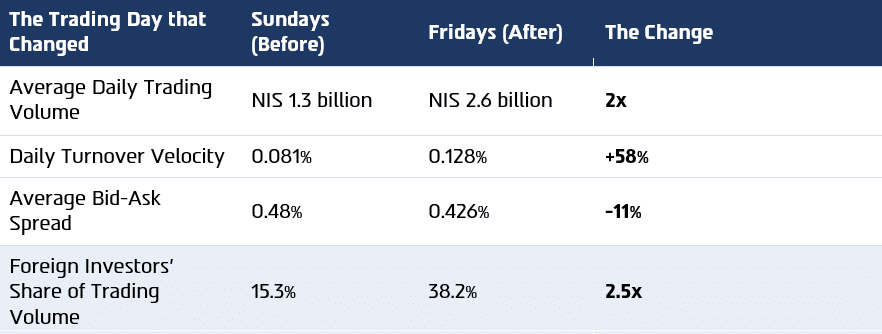
The analysis compares the affected trading day with Mondays through Thursdays, which remained unchanged and serve as the control group.
After controlling the overall market trend, the study attributes to the reform an approximately 40% increase in trading volume and an approximately 39% increase in turnover velocity on the affected trading day.
The most striking finding, however, concerns who is trading. On Mondays through Thursdays, the share of foreign investors remained virtually unchanged (36.3% compared with 36.7%). On Fridays, by contrast, their share more than doubled.
And this occurred despite the fact that Friday is a shortened trading day, with the TASE closing at 8:50 a.m. New York time – before trading opens in the United States.
Disclaimer: The analysis compares six-month “before” and “after” periods, during a period of significant market gains (the TA-125 Index rose by approximately 47%). While the direction of the findings is consistent and clear, their precise magnitude may become clearer as additional data accumulate. It should be noted that the body of the report attributes an approximately 40% increase in trading volume to the reform, while the conclusions section refers to a 57% increase.
What Does This Mean in Practice? Business Opportunities
The report itself is an economic study and does not address regulatory considerations. The analysis below is our own.
Brokers Seeking Direct Market Access – Interest in the various TASE membership routes may increase, including remote membership and proprietary trading (nostro), together with clearing arrangements with a clearing member and the operational preparations required for a shortened trading day.
Market Makers, Algorithmic Trading and AI Interfaces – Tighter spreads and higher turnover velocity may improve the economics of market making in Tel Aviv, including in exchange-traded funds (ETFs).
International Companies, Dual-Listed Companies, and Foreign ETFs – Improved liquidity and a broader foreign investor base may enhance the attractiveness of dual listings and capital raising in Tel Aviv.
Foreign Asset Managers and Institutional Investors – The removal of the trading-week barrier may reduce the costs associated with hedging and operating Israeli positions.
Gornitzky has unique expertise in the fields of investments, trading, and financial instruments. We would be pleased to assist you in assessing the implications for your business, including mapping market-access pathways, navigating licensing processes with the Israel Securities Authority and the TASE, and developing a distribution and marketing framework for Israel.